1.1 Background of the Study
Technology is changing how we help children learn! Computers, phones, and special apps can now help kids with Autism Spectrum Disorder (ASD) learn new things at home. The World Health Organization says about 1 in 100 children have autism, and they need special help early on.
In the Philippines, getting therapy can cost a lot of money - about ₱38,868 per year! That's why many families need help practicing at home between doctor visits.
Aumazing is here to help! It's a fun app with games that teach children ages 2-6 with autism how to learn better through play.
1.2 Objectives of the Study
The main goal of Aumazing is to create a fun 2D game app that uses special computer programs to help young children with autism learn at home.
Our goals:
- 🎮 Create fun 2D games with quizzes and learning levels
- 🤖 Use special computer programs (AI) to check how well kids are doing
- 📊 Help parents see their child's progress
- ⏰ Make sure kids don't play too long
- 💻 Connect families with therapists when they need more help
1.3 Significance of the Study
Aumazing helps many people:
Children - Get fun games to learn new skills!
Parents - See progress and know what to practice!
Therapists - Help more families from anywhere!
Schools - Learn new ways to help all kids!
1.4 Scope and Delimitation
What Aumazing DOES:
- ✅ Works on phones and tablets (Android & iOS)
- ✅ Has fun games for kids ages 2-6
- ✅ Checks learning with quizzes
- ✅ Uses computer programs to suggest learning levels
- ✅ Shows parents their child's progress
- ✅ Controls screen time
- ✅ Helps find therapy centers
What Aumazing does NOT do:
- ❌ Does not diagnose autism
- ❌ Does not replace real doctors
- ❌ Is not for older kids or other conditions
- ❌ Cannot do all therapy types
1.5 Time and Place of the Study
Aumazing is being made from February 2026 to September 2026 at Assumption College of Davao in the Philippines.
Testing will be done with help from parents, teachers, and therapy experts in Davao City to make sure the app works well for families.
1.6 Key Words
ASD - Autism Spectrum Disorder - when someone's brain works differently
Gamification - Making learning fun like playing games
Pre-Assessment - A quiz at the start to see what you know
Post-Assessment - A quiz at the end to see what you learned
AI - Artificial Intelligence - computer programs that learn
1.7 Conceptual Framework
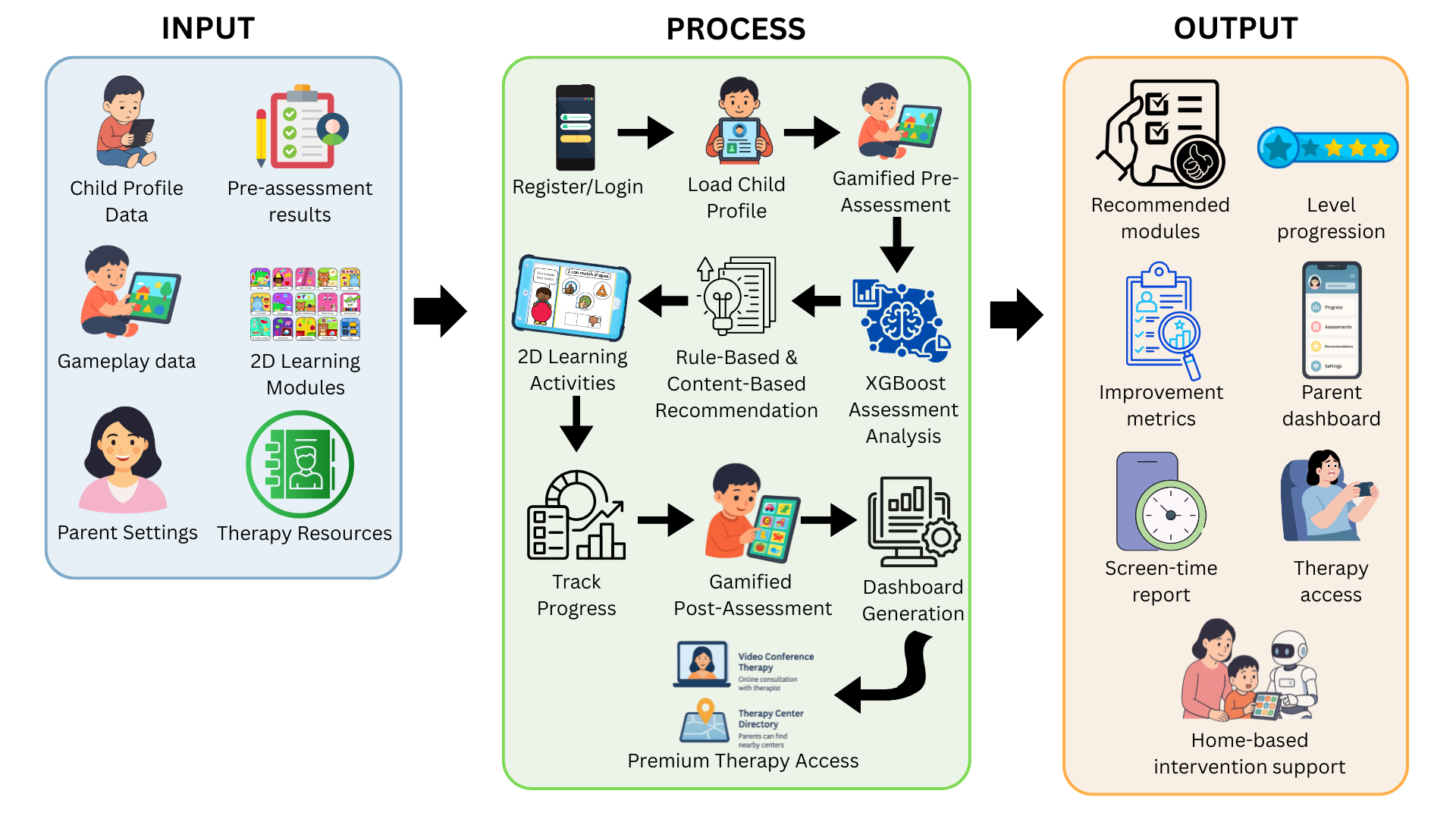
Figure 1.1: Conceptual Framework
The conceptual framework of the proposed system follows the Input–Process–Output model.
In the input phase, the system gathers child profile data, parent information, pre-assessment responses, gameplay performance data, leveled learning content, screen-time settings, and therapy-related resources.
In the process phase, the application performs gamified pre-assessment, analyzes child performance using an XGBoost-based assessment analytics, and applies rule-based and content-based recommendation logic to recommend suitable learning modules, delivers 2D game-based activities, conducts post-assessment, and generates comparative analytics for the parent dashboard while also supporting premium therapy access.
In the output phase, the system produces personalized module recommendations, level progression results, post-assessment outcomes, improvement metrics, dashboard reports, and therapy access features that support early intervention and home-based therapy for children with early-stage Autism Spectrum Disorder.